
A wall curving inward
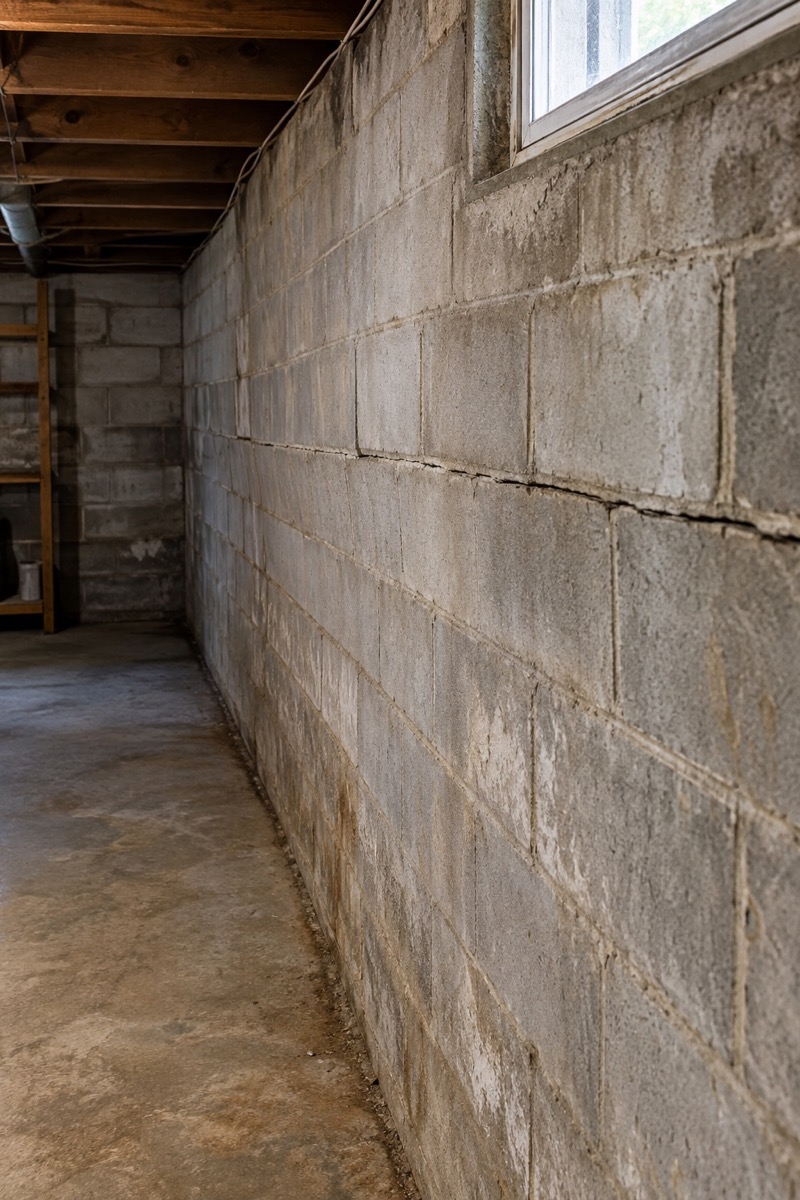
The surface bows most visibly near mid-height rather than remaining in one vertical plane.
Bowing basement wall inspections in Pittsburgh and Southwestern PA
A bowed or leaning basement wall can be alarming, but the visible curve alone does not tell you what repair is necessary. We measure the deflection, evaluate what is driving the pressure and explain whether the condition calls for stabilization, monitoring or drainage improvements.
The surface bows most visibly near mid-height rather than remaining in one vertical plane.
Separation follows a mortar joint where lateral pressure is bending a block foundation wall.
Diagonal separation stepping through masonry joints can show that sections of the wall are moving differently.
Sighting along the wall’s length reveals movement that may be difficult to judge straight on.
Basement walls begin to bow when lateral soil pressure exceeds the wall’s capacity to resist it, often becoming noticeable years or even decades after a home is built.
Understanding what is driving that pressure matters because the appropriate next step depends on whether the force is ongoing, related to drainage or connected to the wall’s original construction.
Water collecting beside the foundation increases hydrostatic pressure against the wall.
Saturated clay expands and exerts greater lateral load, particularly after prolonged wet weather.
A wall with inadequate reinforcement or capacity may be unable to resist the pressure surrounding it.
Wall movement in this region often accelerates after wet seasons, when saturated clay soils exert maximum lateral load against foundation walls.
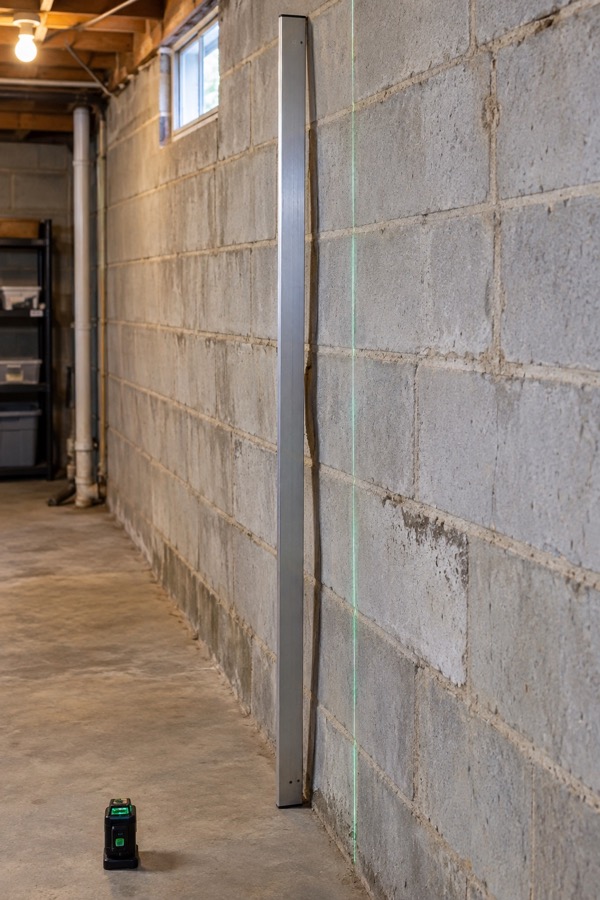
The assessment quantifies deflection at multiple points along the wall’s height because bowing rarely occurs uniformly. A straightedge or laser reference from the top and bottom of the wall shows how far the middle has displaced inward.
The evaluation also examines whether the wall is cracked through its full thickness, which indicates more advanced distress than surface cracking alone.
Minor movement may be managed by reducing the soil and water pressure acting on the exterior face.
More substantial deflection commonly calls for bracing or anchoring to prevent further inward movement.
The amount and pattern of deflection, the condition of the masonry and the likely source of pressure are considered together. That evidence helps determine whether the wall needs prompt stabilization, continued monitoring or improvements that reduce water and soil pressure.
We tell you which walls need repair and which can be watched.
More about foundation inspections →“Gary's professional opinion on a foundation wall saved my client several thousand dollars.”
Lateral pressure from soil bearing against the exterior face of the wall overcomes the wall’s resistance. This typically worsens when clay soils become saturated and expand or when poor drainage allows hydrostatic pressure to build behind the foundation.
Deflection is measured using a straightedge or laser level referenced from the top and bottom of the wall to determine how far the mid-section has displaced inward. Measurements are taken at several points to map the full extent of movement.
Walls deflecting more than two inches or showing full-thickness cracking with visible separation present a higher structural concern and should be evaluated promptly, particularly when movement appears to be continuing.
Improving exterior grading and downspout discharge can reduce ongoing soil pressure, which may stabilize walls with minor deflection. Walls already showing significant movement typically require mechanical bracing or anchoring to prevent further inward displacement.
Walls continue to deflect as long as the pressure driving the movement exceeds the wall’s resistance. This can eventually lead to structural failure, floor-system instability above and water intrusion through widening cracks.
Independent evaluations before you buy, build, repair or renovate. Gary J Miller, PE tells you what the structure actually needs, with no repair systems to sell.